
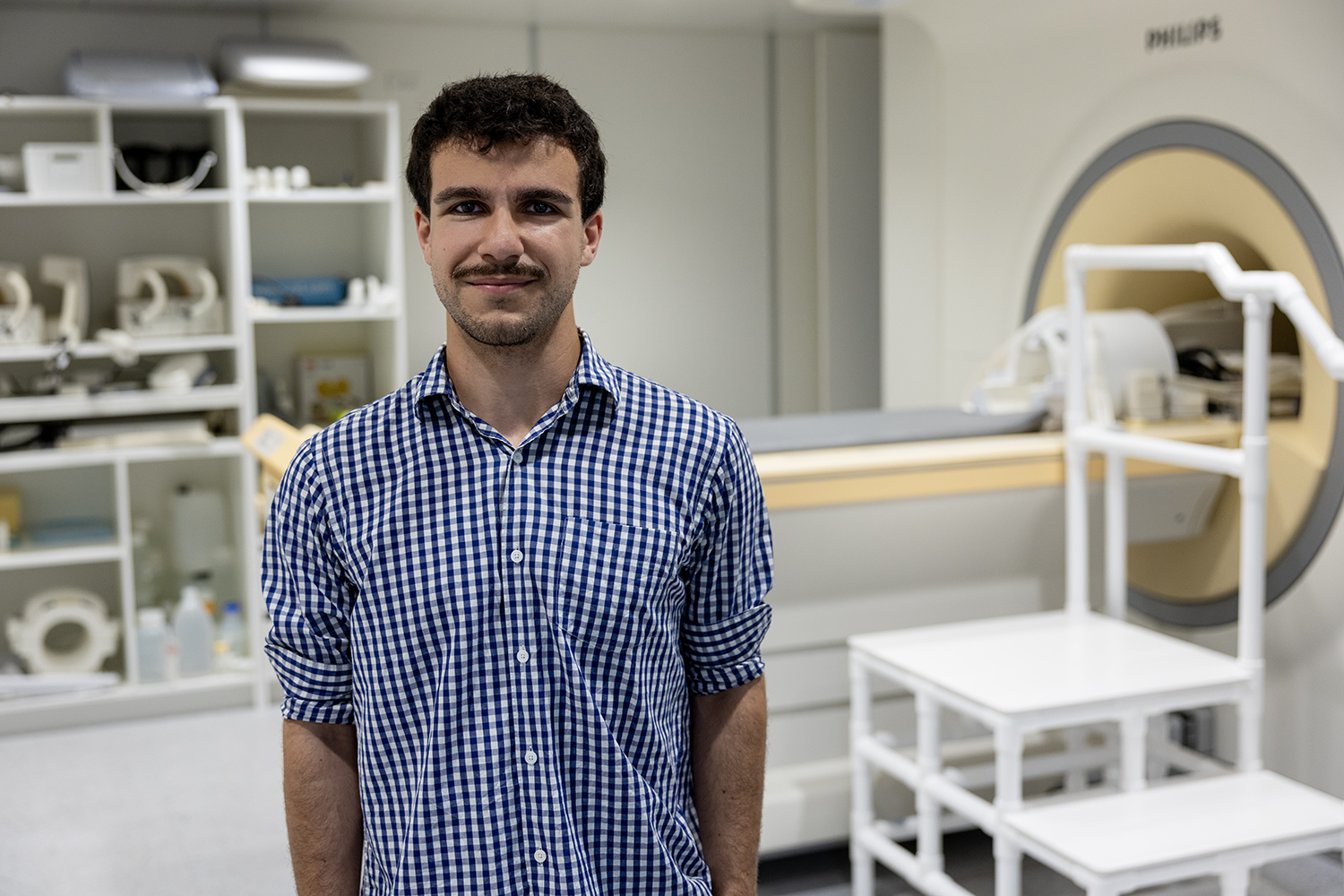
Jesús Díaz Pereira
ABSTRACT:
Purpose: Precise mapping the human cerebral cortex’s laminar organization, the white matter/gray matter interface, and “U-fibres” is essential for understanding neurodegeneration and brain plasticity. However, diffusion MRI (dMRI) of the cortex is currently limited by a “trilemma” of signal-to-noise ratio (SNR), spatial resolution, and acquisition time. While Ultra-High Field (UHF) MRI can provide the necessary resolution, it exacerbates B0 inhomogeneities and geometric distortions. This project aims to develop a novel deep learning framework to overcome these barriers, enabling unprecedented geometrically accurate and high-resolution (~500 µm) in vivo diffusion mapping across cortical layers.
Methods: We propose a two-stage approach leveraging Physics-Informed Implicit Neural Representations (PI-INRs). First, we will develop a PI-INR model to jointly estimate subject motion, susceptibility and eddy-current induced distortions. Unlike traditional image-space tools, our framework operates directly on complex k-space data, preserving phase information to resolve distortions without relying on discretised voxel grids. Second, we will extend this framework into a super-resolution reconstruction framework. The model will be trained to synthesize high-resolution volumes, while mitigating noise, using data from low-resolution acquisition planes. The subject-specific optimization avoids the need for large external ground-truth datasets, which are currently unavailable at UHF.
Significance: This research shifts the paradigm of dMRI processing from discrete interpolation to continuous, physics-grounded modelling. By resolving residual deformations that current “gold-standard” tools fail to address, this work will provide a reliable tool for in vivo cortical dMRI. Furthermore, by optimizing the SNR-Resolution-Time trilemma, the proposed method significantly reduces total acquisition times, making high-resolution protocols feasible for clinical populations. The framework’s ability to correct severe artifacts has broad implications beyond neuroscience for clinical body dMRI and high-resolution functional MRI, making UHF imaging a more robust tool for both research and clinical diagnostics.