
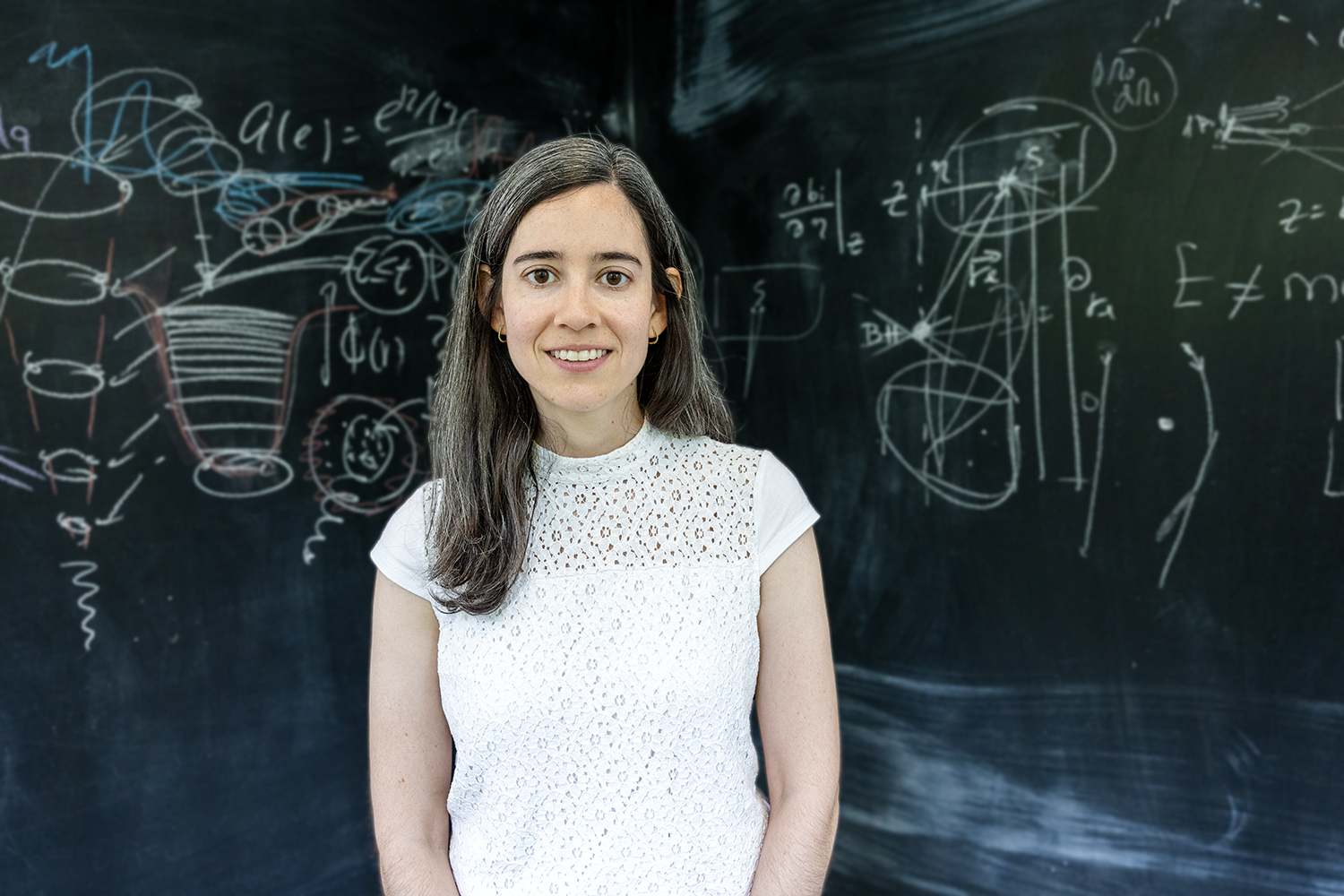
Lorena Magaña Zertuche
ABSTRACT:
The first detection of two black holes colliding, known as GW150914, was announced 10 years ago and led to the Nobel Prize in Physics in 2017. Since then, hundreds of observations have been made with ground-based detectors, including binary neutron star mergers. Detecting signals of these cataclysmic events requires cutting-edge technology and robust waveform modelling. These detections offer opportunities to test Einstein’s theory of general relativity in the realm of strong gravity through probing its various predictions, such as the existence of black holes and the emission of gravitational waves through collisions of these compact objects. One key prediction is known as the gravitational wave memory effect, which is the footprint that gravitational waves leave on spacetime after passing through. Although well known, this effect has been previously ignored since its small signature was thought to be unobservable. However, as we get closer to more sensitive detectors and the theory is increasingly understood, this effect has begun gaining attention and is starting to be included in waveform models.
Similarly, solving Einstein’s Equations through the use of supercomputers has been done in a way that often suppresses this effect. Within the past 5 years, however, simulations that include this effect have become publicly available and are being used to better understand the fundamental physics behind black hole binary mergers. Nevertheless, this is computationally intensive as it can take weeks to months to solve the equations for a single binary. This is why the use of machine learning to create quick and robust surrogate models has entered the field. We propose to use machine learning to build a surrogate model that predicts the time-dependent memory signal and test its detectability using data analysis tools.
With the next generation of detectors, hundreds to thousands of signals with a noticeable memory effect are expected to be observed. Not only is a quick turnaround time of parameter inference crucial, but the inclusion of the memory effect provides an additional way to constrain the inferred initial black hole parameters, breaking degeneracies and allowing us to do more accurate studies. Therefore, taking into account this effect will allow us to take full advantage of the physics encoded in our data. This is particularly important in cases where mismodelling a signal may mimic effects beyond general relativity, hinting towards new physics.