
“YES!”
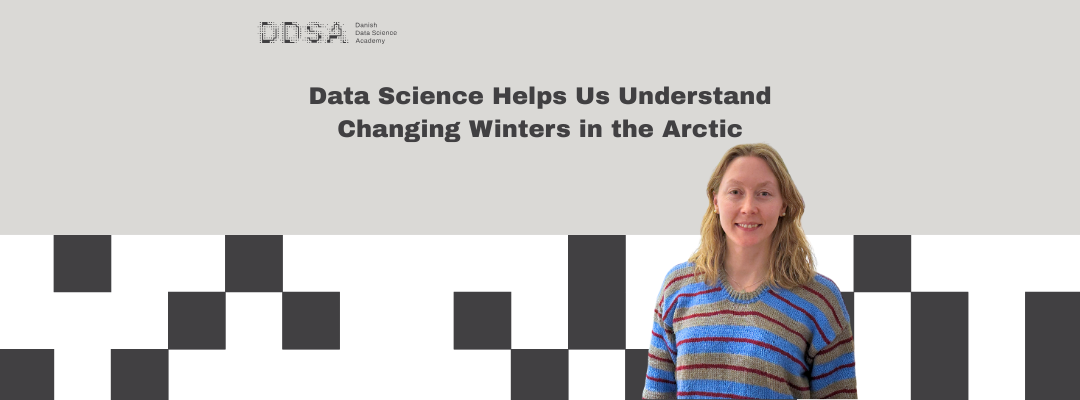
That was the clear and unequivocal response when Laura Helene Rasmussen – who has frequently spent time in Arctic regions – once asked a group of Sámi people whether they had experienced more variable winters in recent years.
Laura, who holds a PhD in Geography and Geoinformatics from University of Copenhagen and is now a postdoctoral researcher at the Statistics and Probability Theory section at University of Copenhagen with funding from DDSA, was not surprised by their answer. She had already observed that the Arctic winter climate is changing rapidly, with more variable snow depths, shifting timing of spring snowmelt, and more frequent midwinter thaw events.
In short, Arctic winters have become unstable.
The Arctic is the most northern region on Earth, primarily consisting of the Arctic Ocean surrounded by the northern parts of Europe, Asia, and North America, including Greenland. The region is characterized by extreme cold, sea ice, permafrost, and tundra, where the average temperature of the warmest month does not exceed 10°C.
When asked why the Arctic is so important, Laura Helene Rasmussen responds:
“The Arctic is warming four times faster than the rest of the globe! And it’s an extraordinary environment up there.”
In fact, she moved to Tromsø, Norway, this winter to continue her postdoctoral research, which focuses on quantifying these increasingly unstable winters – on measuring how the Arctic winters have become “weird.”
The changes currently taking place during winter in the Arctic are something we must understand in order to fully comprehend climate change in the region – and potentially elsewhere as well.
However, before drawing any valid conclusions, it is essential to establish a robust data foundation from the countries surrounding the Arctic covering the past 30 years. In other words, this requires creating harmonised climate measurements from all Arctic regions – countries that use widely differing measuring systems and methodologies, ranging from Russian to Norwegian approaches and from land areas around the Greenland Ice Sheet.
DDSA’s communities were a major support
These data could not be made meaningfully comparable without data science – at least not easily.
“To create this Arctic data set in a standardised format, I needed a vast amount of data. Natural science is limited if we don’t have shared data of comparable format, structure and quality. I gathered data from across the pan-Arctic region, including Russian datasets, which however stopped being reported in 2022 because of the war in Ukraine. They had otherwise reported data since 1945. From Greenland, I found most systematic data collection after 1990, while in Scandinavia, the first reported data I found was from around 1900. Normalising those data sets into one was where data science truly was useful, because I wouldn’t have been able to do it without the automatised data pipelines that I set up. I benefited greatly from the experts in DDSA’s communities in this process. I didn’t know of many of the methods,” Laura explains.
Moreover, although her academic background had primarily focused on geoscience and related disciplines, Laura collaborated with skilled data science researchers at the University of Copenhagen and also taught herself to code for the project.
“It was very much learning by doing. Data science has already been extremely useful for me, and it’s incredibly exciting. I will probably never become a full-fledged data scientist, but I have become enough of a data scientist for opening up entirely new types of research questions in the intersection between geoscience and data science. I know that there is a wealth of high-quality data out there, and that should be used to answer important questions with the tools and expertise found in collaborating with data science,” the researcher says.
Today, she hopes that the freely available, interoperable and quality checked data she has compiled covering the past 30 winters from no fewer than 700 monitoring stations across the Arctic, can deepen our understanding of climate change. “I also hope that my pan-Arctic dataset can benefit other researchers and generate new knowledge. At the very least, we now have a shared foundation to build upon,” says Laura Helene Rasmussen.
Read more about Laura’s work here:
A pan-Arctic terrestrial in situ weather dataset from 1990-2023 collected from publicly available data sources | Scientific Data
Pan-Arctic weather data set from publicly available in situ measurements from 1990-2023