
Sustainability has long been haunted by the “how-to” gap. While the world identified the crises – plastic-mountains in the oceans, food insecurity, and carbon-heavy manufacturing – the solutions remain challenging.
But according to the young researcher, Niklas Gesmar Madsen, and many other scientists around the world, the enzymes which are nature’s own catalysts, play a key role in re-envisioning these concepts.
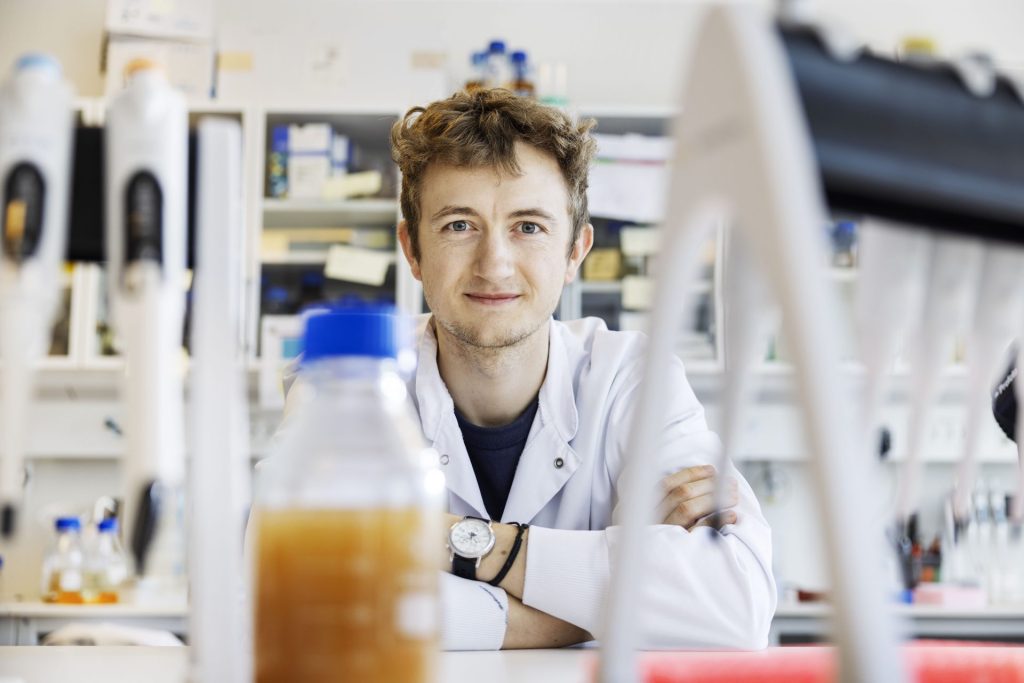
In Copenhagen’s backyard, Niklas Gesmar Madsen is working in the field of protein engineering. Niklas is currently pursuing his DDSA-funded PhD at the Novo Nordisk Foundation Biotechnology Research Institute for the Green Transition, with enzymes as the central focus of his research. While most of us only encounter enzymes as the invisible force in our laundry detergent, allowing for cold-water washes, their potential is much more. They are to be found everywhere, Niklas thinks:
“Life does not exist without enzymes. They make our bodies function. Even so, much more is possible with enzymes than only life,” says Niklas.
This ‘much more’ is in his mind the alchemy of the 21st century: using data and protein engineering to redesign nature’s catalysts for a sustainable industrial future.
Enzymes are the molecular scalpel, moving, transforming, and precisely changing the matter it catalyses. This allows plastic waste to be degraded and recycled or converted to a pharmaceutical like paracetamol. Even CO2 capture may be possible, with an enzyme that catches the gas and converts it to a small molecule called formate.
Enzymes are ‘dancing’
To the uninitiated, an enzyme looks like a dry string of letters a biological alphabet. The alphabet has twenty characters, and a sequence may look like “MAKLV….”. To us it does not look like a language.
Niklas views these sentences through a less infinite and more lyrical lens. If a protein sequence is a poem, its meaning isn’t found in the static words on the page, but in the rhythm it creates.
Enzymes are not static as they perform their chemistry. They dance. They vibrate, bend, and flex in a highly coordinated rhythmic movement to capture molecules and facilitate chemical reactions. This “catalytic dance” is what enables a functional molecular machine.
Understanding this rhythm is the key to moving beyond what nature gave us and toward what we need. But understanding this dance required a different kind of advancement — not in wet labs, but in data. In the 1980s, the biotechnology revolution taught us how to repurpose natural enzymes.
Later, Frances Arnold’s Nobel-winning work on directed evolution allowed us to “speed up” nature’s clock to evolve new traits. That is to say: take an enzyme from nature and engineer it for new function.
Recall the sequence, “MAKLV….”, well by virtue of looking like a language ChatGPT like models have become common in the field. This is partly due to the immense peta-scale databases which have become available since. The so called: “Protein Language Models” are data science’s answer to modernizing enzymes, which are commonplace in industry and Niklas’ work.
While a lot of focus has been placed on sequence, attention was also given to structure. In water, these nano-machines look like machine too. Each atom is exactly where it needs to be. AI-based structure prediction won the 2024 Nobel Prize in Chemistry. What’s next, what’s the frontier?
Niklas’ work is next stage in enzyme research
The next stage are the “rhythms” which Niklas studies. It is becoming crucial to fine-tune the molecular motions by slightly altering the ‘grammar’ of the sequence. Data science is key here. Observing the molecular dance experimentally is difficult and costly, but simulation allows for a computational microscope to “see” enzyme vibrations.
By feeding these models data on how enzymes move and vibrate, researchers are moving toward design tools that don’t just mimic nature – they improve upon it. Whether it’s capturing CO2, degrading plastic, or brewing pharmaceuticals in microbes, data science is the prerequisite of 21st century Alchemy.
Why data science? Why enzymes? And why Copenhagen?
To Niklas, the answer is clear: density.
“We have the data, the experimental methods, and the applications in sight – all in one place.”
In few other places do data science, molecular biology, and industrial biotechnology come so close together. Copenhagen is today a Hub for protein engineering. A concentration of talent, funding, shared initiatives like the DDSA, and institutions collaborating across disciplines.
The Hub ensures protein engineering does not live only in simulation or only in the lab. It lives in the collaborations between data scientists, biologists, and biochemical engineers. This is what enables 21st Century Alchemists to find the “how-to” gap in sustainability.
One of the major players in the hub is the Danish company, Novonesis, who engineers and produces these rhythmic molecules. And meanwhile, two new Protein Design and Engineering centres at Technical University of Denmark (DTU) and University of Copenhagen (KU), are being established.
In summary “a protein renaissance” is underway in Denmark.
“What is fantastic about enzyme research is that there is always another level beyond what you think you understand,” Niklas reflects.
As he nears the middle of his PhD, his goal is clear: to bridge the gap between the fundamental rhythm of an enzyme and the industrial-scale solutions enzymes may enable.